


Kansa Wand: What It Is, What It Does and Why the Alloy Matters
Among the tools used in classical Ayurvedic practice, Kansa stands apart. Unlike jade rollers, gua sha stones, or modern facial massage devices — which are largely recent innovations — Kansa has a documented place in the classical Ayurvedic tradition as a therapeutic material. The Kansa wand used in facial massage, the larger Abhyanga wand used on the body, and the bowl-shaped Kansa tools used in traditional practice are all contemporary applications of a material that has been part of Ayurvedic and Vedic daily life for centuries.
This guide covers what Kansa is as an alloy, why it was used therapeutically in the classical tradition, what the main tools are and what each does, and how to choose and use them correctly.
What Kansa Is — The Classical Alloy
Kansa (also written Kamsya or Kāṃsya in Sanskrit) is a ternary alloy — an alloy of three metals — composed primarily of copper, with tin as the secondary component and small amounts of zinc. The classical proportion in genuine Kansa is approximately 78–80% copper with most of the remainder being tin.
This is not the same as bronze (copper and tin in different ratios), brass (copper and zinc), or any copper-coated modern metal. The specific composition of classical Kansa — and the traditional hand-casting method used to produce it — gives the alloy its characteristic properties: a warm, dense weight in the hand; a distinctive resonance when tapped; and a surface quality that interacts with the skin differently from stone, steel, or modern copper.
Classical Ayurvedic texts including the Ashtanga Hridayam describe Kansa among the metals and materials used in therapeutic practice. Kansa vessels (Kamsya Patra) appear consistently in classical Vedic and Ayurvedic dietary context as the preferred material for eating — a practice still observed in traditional households in India today, where food served on Kansa plates is considered beneficial to digestion and overall health. The same material properties that made Kansa the classical choice for eating vessels inform its therapeutic application in massage.
Why Kansa Is Used in Ayurvedic Massage
The classical Ayurvedic understanding of Kansa draws on Dhatu Guna Shastra — the classical study of the properties of metals and materials. Copper, the dominant metal in the alloy, is described in classical Ayurvedic material science as having warming energy (Ushna Virya), purifying quality (Shodhana), and a natural action of balancing Pitta through the skin. Tin, the secondary metal, is described as having lighter, slightly cooling properties — giving Kansa a more balanced quality than pure copper tools.
The result is an alloy that is simultaneously warming and balancing: one that generates gentle heat through the friction of massage, has a naturally antimicrobial surface quality (copper's antibacterial properties have measurable scientific support), and interacts with the skin's surface in a way that pure metal tools do not replicate.
In the context of Ayurvedic massage, Kansa tools are used to:
Support lymphatic circulation in the face and body. The combination of gliding pressure and the tool's mass produces consistent stimulation of the superficial lymphatic pathways of the face and neck — relevant in a tradition where facial congestion (Kapha accumulation) is understood as a primary factor in puffiness, dullness, and uneven tone.
Work with marma points — classical Ayurvedic vital points. The face contains a significant number of marma points — energetic junctions described in classical Ayurvedic anatomy that connect the surface of the body to deeper physiological and energetic systems. Kansa tools, used with specific gliding and circular movements over these points, are considered to activate and harmonise them. The guide to marma points in Ayurveda covers the classical marma system in full.
Balance Pitta through the skin. Pitta — the Dosha of heat, metabolic activity, and transformation — tends to accumulate in the face, particularly around the eyes, temples, and forehead. The cooling-balancing quality of Kansa, applied through massage, is classically considered to reduce surface heat and the Pitta-related manifestations that come with it: redness, inflammation, and a flushed or reactive complexion.
Ground and calm the nervous system. From a Vata perspective, the steady, rhythmic pressure of Kansa massage — particularly in a facial context — supports the settling of Prana Vata, the aspect of Vata that governs the sensory system and mental activity. The weight and warmth of the tool in sustained contact with the face produces a calming, grounding effect consistent with the classical principle of using physical contact, warmth, and rhythm to settle an elevated Vata nervous system.
The Main Kansa Tools: What Each One Does
The Kansa wand is not a single tool but a family of instruments, each shaped for a different application.
The Kansa Wand (Facial Massage Tool)
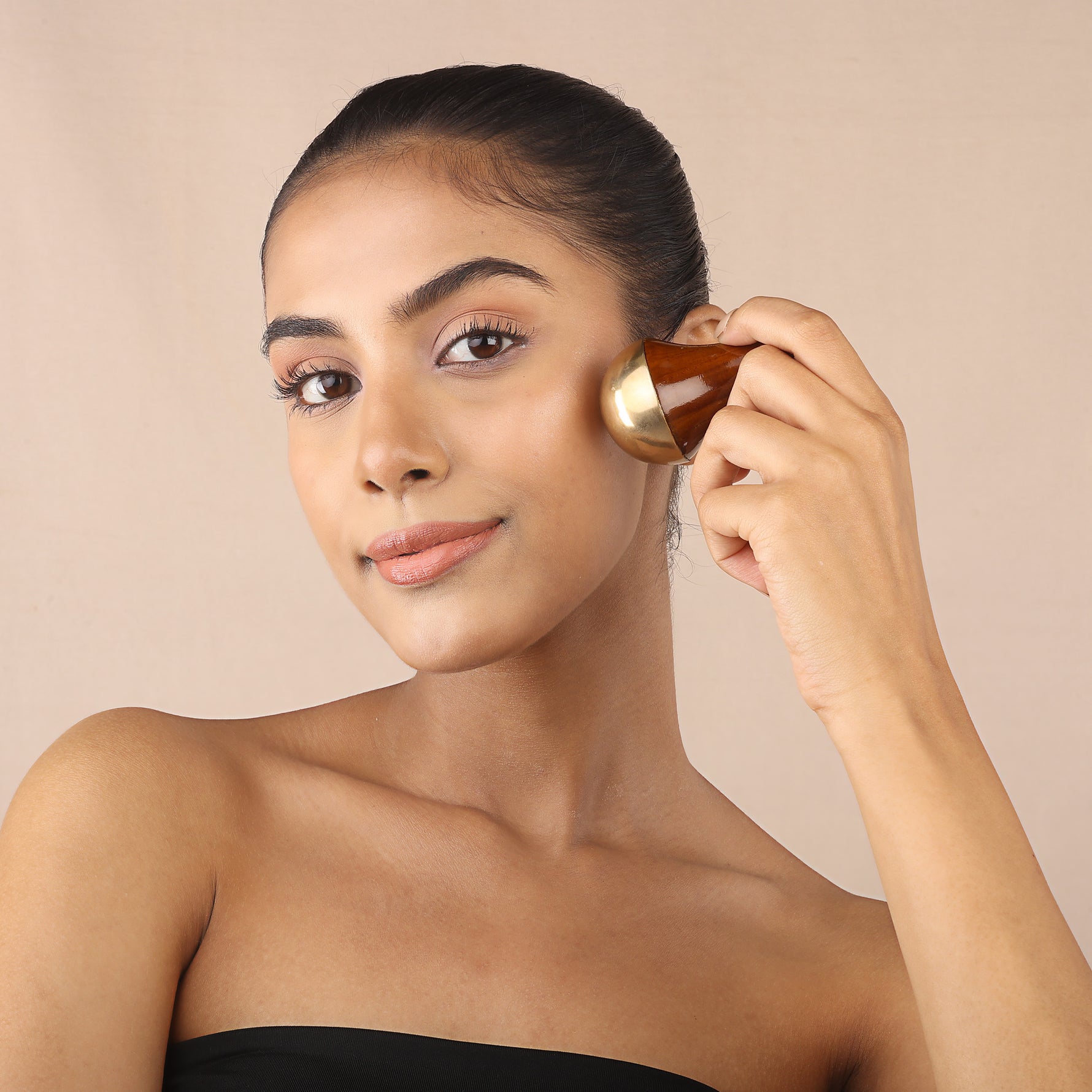
The facial Kansa wand is a hand-held tool with a smooth, dome-shaped Kansa head mounted on a wooden or bamboo handle. The dome — typically 5–6 cm in diameter — is sized to fit comfortably over the contours of the cheek, forehead, and jaw, allowing the therapist or individual to use gliding, circular, and figure-eight movements across the face.
The facial wand is used on the face, neck, and décolletage, always with a thin layer of appropriate facial oil — traditionally a classical mukha taila such as Eladi Tailam or Kumkumadi Tailam — to allow smooth gliding without friction. The complete technique, movement sequence, and how to combine the wand with Ayurvedic face oils is covered in the Kansa wand face massage guide.
The Kansa Abhyanga Wand (Body Massage Tool)
The body Kansa wand has a larger Kansa head — typically 7–8 cm — and a longer handle, shaped for application to the back, legs, arms, and larger muscle groups of the body. It is used in Kansa body massage as part of a broader Abhyanga practice, applied over warm Ayurvedic massage oil with longer gliding strokes suited to the larger surface areas of the body.
The body wand is particularly associated with application to the soles of the feet — Pada Abhyanga with Kansa — a classical practice referenced in Ayurvedic texts as one of the most effective daily self-care techniques for calming the nervous system, supporting sleep, and grounding Vata. The Kansa body massage guide covers technique, oil selection, and the classical tradition of Kansa foot massage in detail.
The Kansa Bowl (Kamsya Patra)
A smaller category of Kansa tool is the bowl or plate form — the original vessel shape that Kansa has been associated with across millennia of Vedic and Ayurvedic tradition. In a contemporary therapeutic context, small Kansa bowls are sometimes used in a warming hand massage (the bowl is warmed in the palm and pressed gently against body parts requiring sustained heat and Kansa contact). This is a more specialised application, typically encountered in professional Ayurvedic treatment settings rather than home practice.
How Kansa Feels in Use — What to Expect
First-time Kansa users sometimes notice something unexpected: a grey or darkish residue on the skin after using the tool. This is not a defect and is not cause for concern. It is an electrochemical reaction between the copper in the Kansa alloy and the naturally acidic surface of the skin, and it is considered in classical Ayurveda to be an indicator of the tool drawing Pitta-related acidity from the skin's surface. The more elevated the Pitta constitution or the more reactive the skin, the more pronounced this reaction tends to be. It wipes away easily with a cloth and diminishes with regular use as the skin's surface balance shifts.
The warmth generated during use is another characteristic quality. As the Kansa head glides across the skin, friction produces gentle heat — a sustained, localised warmth that is quite different from applying a warmed stone. It is the friction itself, combined with the thermal conductivity of the alloy, that generates it.
Choosing a Kansa Tool: What Genuine Looks Like
The quality difference between a genuine Kansa tool made from the correct alloy and an imitation matters practically. Tools made from aluminium, brass, or copper-plated modern metals feel different in the hand, generate heat differently during use, and do not produce the same interaction with the skin.
When selecting a Kansa tool, look for:
Alloy specification. A genuine Kansa supplier states the composition of the alloy explicitly. Traditional Kansa is approximately 78–80% copper with the balance primarily tin.
Handcrafted production. Traditional Kansa tools are hand-cast and hand-finished. The weight, density and surface quality of a hand-cast Kansa dome differs from a machine-produced alternative.
Weight and resonance. A genuine Kansa tool has a noticeable weight relative to its size, and produces a clear resonant tone when tapped. Lightweight or dull-sounding tools are unlikely to be the correct alloy.
Smooth, even dome surface. The massage surface should be perfectly smooth with no seams, rough spots, or sharp edges — all of which would cause friction rather than gliding.
For guidance on where to find genuine Kansa tools in Europe and what to look for from a supplier, see where to buy authentic Ayurvedic products in Europe.
Kansa in a Broader Daily Practice
The Kansa wand works best as part of a broader Ayurvedic practice rather than as a standalone beauty tool. In classical Ayurveda, the face and body are not treated in isolation — they are understood as part of an integrated system, and the most consistent results come from daily practices that address the whole person.
The most effective context for Kansa facial massage is as part of a morning Dinacharya sequence that also includes facial cleansing, application of appropriate face oil, and potentially other Ayurvedic facial practices. The guide to Ayurvedic facial massage covers how to build this sequence.
For the body, Kansa foot massage and body massage work best in combination with warm classical Abhyanga oil — the combination of oil's nourishing properties and Kansa's surface interaction being greater than either alone. The guide to Ayurvedic self-massage provides the full Abhyanga framework.
For a complete guide to traditional Ayurvedic facial tools — how Kansa compares with other classical instruments and how to combine them in a facial ritual — see traditional Ayurvedic facial tools. For the full range of at-home Ayurvedic practice tools, see the self-massage tools guide.
Who Kansa Massage Is Particularly Suited To
Kansa massage is broadly appropriate for most people. In classical Ayurvedic terms, certain constitutions and circumstances benefit most:
Pitta types and Pitta-dominant conditions: The balancing-cooling quality of the Kansa alloy and the lymphatic action of facial massage directly addresses the tendencies associated with Pitta — heat in the face, reactive skin, redness, congestion around the jaw and forehead. Those with a Pitta constitution often find Kansa facial massage among the most effective daily practices.
Vata types and Vata-dominant conditions: The weight, warmth, and steady rhythmic contact of Kansa massage grounds and settles an elevated Vata system. The foot application — Kansa Pada Abhyanga — is considered classically significant for Vata balancing, as the soles of the feet contain Vata-connected marma points whose stimulation has a system-wide calming effect.
Anyone building a daily Ayurvedic self-care practice: Kansa tools are among the most sustainable daily practice tools — they require only a small amount of oil, take 5–10 minutes for a face practice, and produce consistent results with regular use.
For personalised guidance on which tools and practices are most appropriate for your constitution, an Ayurvedic consultation with an AYUSH-certified Ayurvedic doctor provides a full assessment.
Kansa massage tools are traditional self-care instruments rooted in classical Ayurvedic practice. They are not medical devices and are not intended to diagnose, treat, cure or prevent any disease. For personalised guidance, consult a qualified Ayurvedic practitioner.


